Key concepts
RAG (retrieval augmented generation)
Retrieve relevant context from your own data before the model answers.
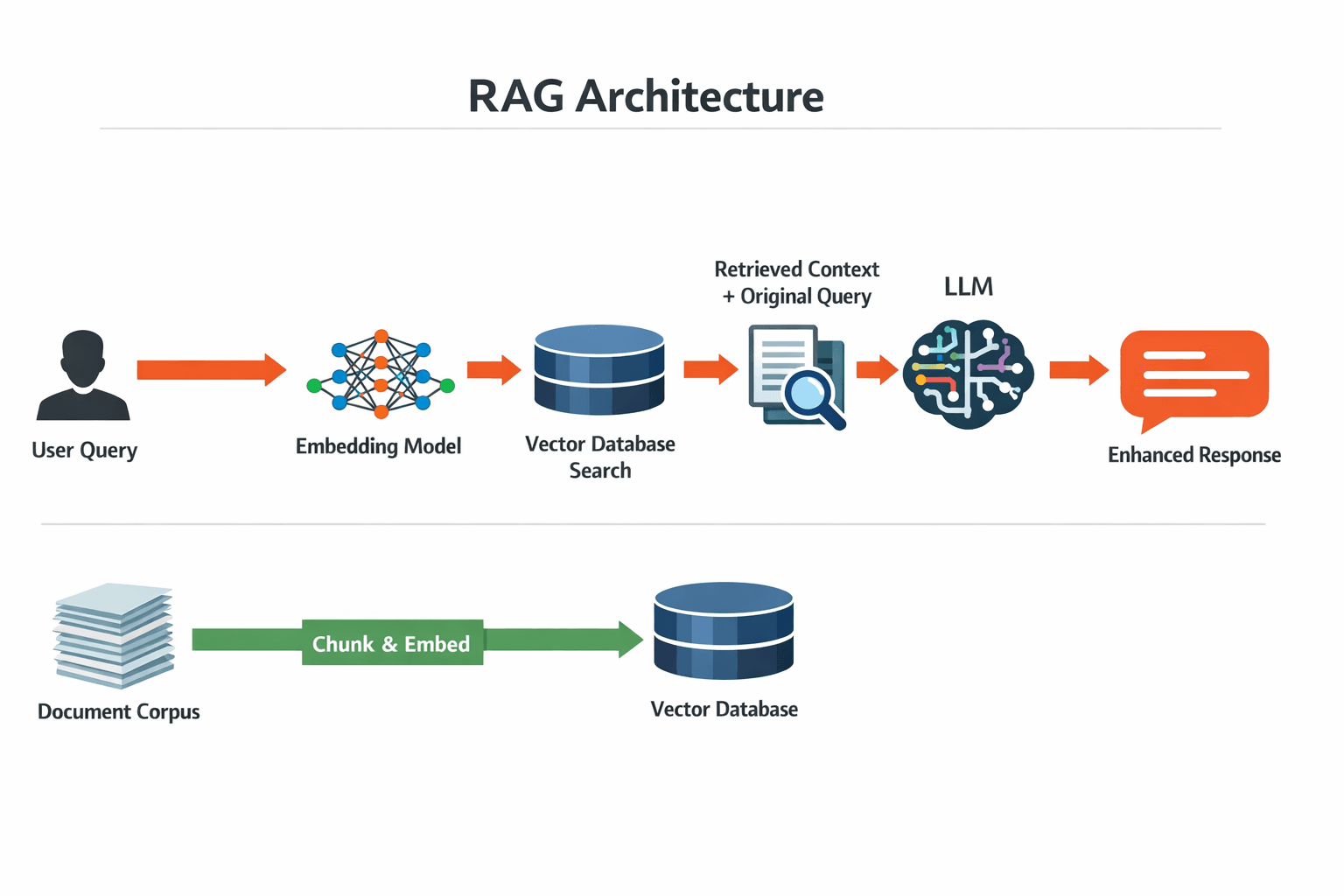
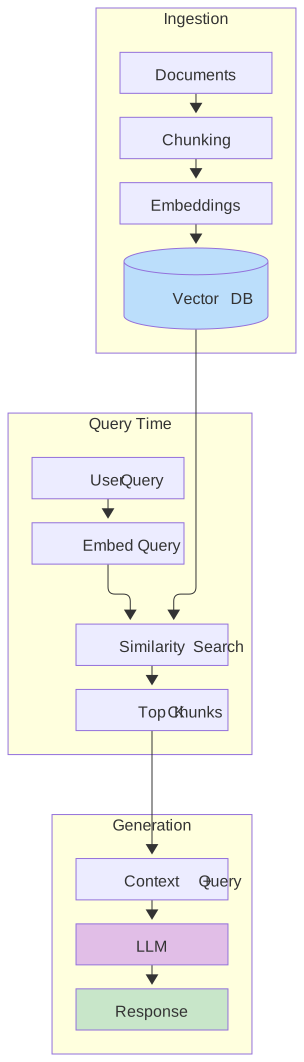
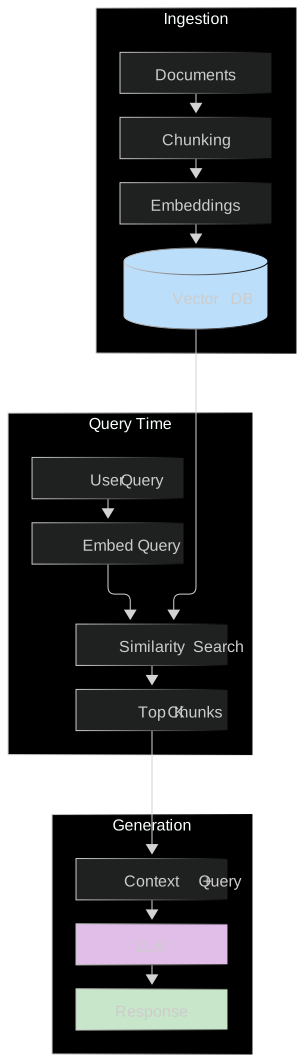
First question: do you need RAG at all? With 1M-token context windows, a well-scoped tool call or passing the documents directly is often simpler, cheaper to build, and easier to debug. RAG is worth its complexity when the corpus is large, changes often, or has per-user permissions.
RAG implementation guide
Step 1: Choose the stack
| Component | Options | Recommendation |
|---|---|---|
| Vector DB | PGVector, Pinecone, Weaviate, Qdrant | PGVector if you already run Postgres. One less system to operate |
| Embeddings | Voyage, OpenAI, Cohere, local (nomic-embed) | Voyage for quality, local for privacy |
| Chunking | Docling, LangChain, LlamaIndex | Docling (PDFs, tables, images) |
| Framework | LangChain, LlamaIndex, raw API | Raw API until a framework clearly saves work |
Step 2: Set up the vector store
docker run -d --name pgvector \
  -e POSTGRES_PASSWORD=password \
  -p 5432:5432 \
  pgvector/pgvector:pg16

psql -h localhost -U postgres -c "CREATE EXTENSION vector;"
CREATE TABLE document_chunk (
id SERIAL PRIMARY KEY,
content TEXT NOT NULL,
embedding vector(1024), -- match your embedding model's dimension
source_file TEXT NOT NULL,
chunk_index INT NOT NULL,
acl TEXT[] NOT NULL, -- who may retrieve this chunk
created_at TIMESTAMP DEFAULT NOW()
);
-- HNSW needs no training data and handles inserts well
CREATE INDEX ON document_chunk USING hnsw (embedding vector_cosine_ops);Step 3: Chunk documents
from docling.document_converter import DocumentConverter
from docling.chunking import HybridChunker

def chunk_document(path: str) -> list[dict]:
    doc = DocumentConverter().convert(path).document
    return [
        {"content": chunk.text, "source": path, "index": i}
        for i, chunk in enumerate(HybridChunker().chunk(doc))
    ]
Step 4: Embed and store each chunk with its source and access list. Batch the embedding calls. Store the model name with the vectors so you know what to re-embed when you switch.
Step 5: Retrieve and generate
-- Top 5 chunks the current user is allowed to see
SELECT content, source_file
FROM document_chunk
WHERE acl && $2
ORDER BY embedding <=> $1
LIMIT 5;
Put the retrieved chunks, with their sources, in the prompt, and ask the model to cite them.
Step 6: Optimize, with measurements
| Technique | When | How |
|---|---|---|
| Hybrid search | Recall misses exact terms | Vector plus keyword (BM25) |
| Reranking | Precision is low | Rerank the top 50 before taking 5 |
| Query rewriting | Ambiguous queries | Model rewrites the query before search |
| Chunk overlap | Answers span chunk edges | 10-20% overlap |
| Metadata filters | Large corpora | Filter by date, source, type first |
What makes RAG fail in production:
- Stale sources. Own the ingestion pipeline, not just retrieval. Wrong documents corrupt every answer
- Missing access control. Retrieval must respect the same permissions as the source system
- Tuning blind. Build a labeled eval set (questions with known right sources) before changing chunk sizes or models
Embeddings
Embeddings match meaning rather than keywords: "cancel my plan" finds the doc titled "Subscription termination". They also cut tokens, because you retrieve less, more relevant text.
Choosing a model:
- Voyage: when retrieval quality is critical (legal, medical, support)
- OpenAI text-embedding-3-small: a solid, cheap default
- nomic-embed-text (local): privacy requirements or very high volume
Switching embedding models means re-embedding everything. Record which model produced each vector.