Context management
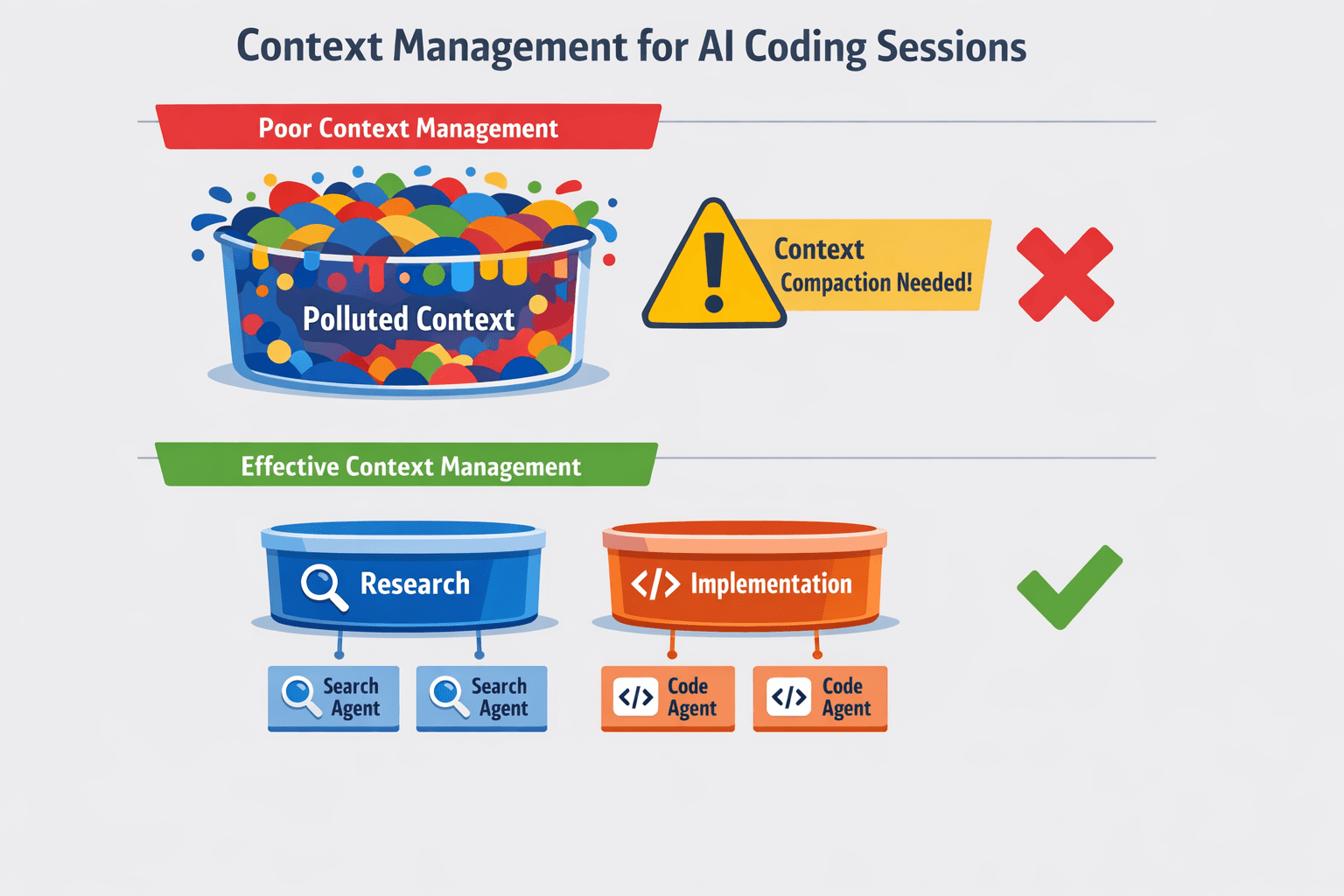
Context is the agent's working memory, and quality drops as it fills with noise. The staff-level decision is where durable context lives: in files (plans, ADRs, CLAUDE.md, memory), not in chat history that disappears on /clear.
Avoid compaction
Quality drops after compaction. Keep sessions focused.
- Separate sessions for research and implementation
- Use subagents to search without filling the main context
/clearbetween tasks
Best practices
- Write precise prompts. Extra words are noise
- Research in one session. Execute in a fresh one with the plan file
- Have different agents cross-check plans
- Use Markdown instead of plain text for structure
A standard handoff format lets any engineer or agent resume any task: a plan file with goal, decisions, status, and next step. The same file works as onboarding material.
Structured prompts for multi-part tasks:
[TASK] JWT auth for Express API
[CONTEXT] PostgreSQL, existing users table
[CONSTRAINTS] Use src/auth/ patterns, no new deps
Use structure only for multi-part tasks. Simple prompts don't need it. For compact structured data in prompts, see TOON: https://github.com/toon-format/toon
Example prompts:
Starting fresh:
"New session. Read AUTH_REFACTOR_PLAN.md and pick up at the next unchecked step."

Handing off:
"Update AUTH_REFACTOR_PLAN.md with what's done, what's decided, and what's next."

Delegating:
"Have a subagent investigate the caching issue and write findings to CACHE_DEBUG.md."
Restart for a reason. If a session is working, don't restart it on a schedule. Modern models handle long sessions well when the task is coherent. Restart when the task changes, not when a timer says so.